Circle, Rows or Small Tables?
Circle, rows or small tables: choose a room layout that supports the conversation, presentation or shared task, and make participation easier to join.

The usual mistake with room layouts is to put chairs in a circle before deciding what people need to do. That can make a presentation hard to see, while rows can leave a conversation feeling like an audience with no obvious way in. Choose a layout for the activity, and you spend less of the gathering asking people to work around the furniture.
What will people actually be doing?
Before moving chairs, write down the main activity in one plain sentence: “We need to hear several views”, “We need everyone to see the demonstration table” or “Pairs will compare suggestions.” If the plan contains several activities, note their order. The room may need to change shape between them.
Then identify what participation means in practice. People might speak to the whole group, listen and take notes, talk in pairs, handle materials, or move between stations. A layout supports some actions more readily than others; it cannot make an unclear activity clear.
Check the room itself. Notice the entrance, windows, screens, fixed furniture, noise from adjoining spaces and the route to any shared materials. Keep a clear path through the room, and avoid arranging seats so late arrivals must cross the centre of a discussion to find a place.
When does a circle help?
A circle makes faces and turns in the conversation relatively easy to see. It suits a group discussion where people are expected to listen to one another, respond, and share the floor rather than address a single focal point.
Use a full circle when the group is small enough for people to hear each other without raising their voices. For a larger gathering, a broad horseshoe can preserve a common focus, such as a facilitator or display, while leaving the centre open. The open end also gives people a natural route in and out.
Circles have limits. Everyone is visible, which can feel exposed to someone who would rather listen before speaking. A circle can also make a screen, map or demonstration awkward to view. If people need to read or mark up documents, provide a surface rather than expecting knees to become desks.
For a conversation that includes a short presentation, consider a horseshoe rather than a closed ring. Keep the speaker near the open end and check that no one has to twist round to see the visual material. If the visual is not essential, leave it out; furniture should not be arranged around a screen merely because the screen exists.
When are rows the sensible choice?
Rows work well when people need to face one direction: a short briefing, a talk, a screening or a demonstration with one clear focal point. They make sightlines straightforward and use the floor space simply. They are also easy to understand on arrival; the chairs make a fairly direct promise about what is about to happen.
The drawback is that rows position people as listeners. A question-and-answer session can still work, but a discussion between neighbours is less natural, and a speaker may receive most of the attention by default. If participation matters, build in a way to turn towards another person or briefly form pairs.
Leave enough room for people to reach seats without squeezing past others. If the group includes anyone who needs a particular route, seat location or clear view, ask discreetly beforehand and adjust the arrangement. Avoid making an individual explain an access need in front of the room.
What do small tables make easier?
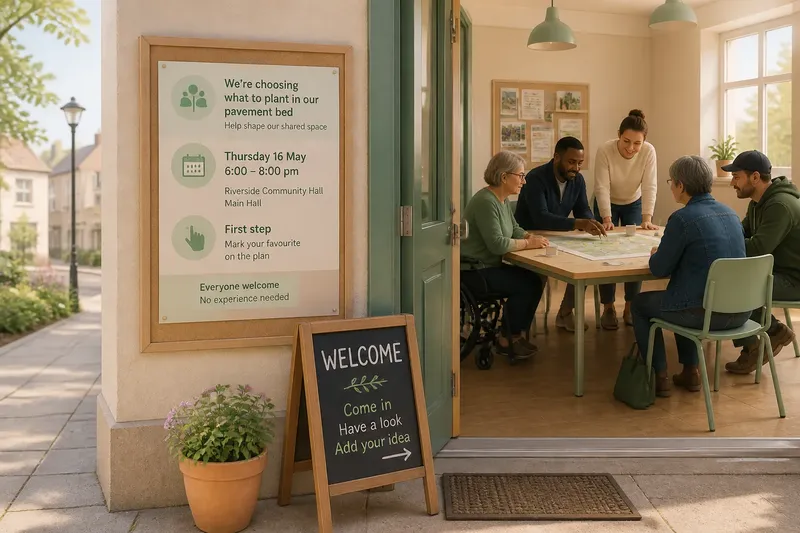
Small tables suit tasks that benefit from conversation among a few people: comparing ideas, sorting cards, annotating a map or making a shared decision before reporting back. A table gives people somewhere to place paper, pens and objects, and it lets a quieter voice enter a smaller conversation before the whole group hears it.
Tables can also divide a gathering into islands. People may keep talking within their group even when the activity calls for listening across the room. Place tables so they can see a shared focal point, and make the reporting-back format clear: one point per table, a written note, or a spokesperson chosen by that group.
Use the smallest number of chairs that still lets each group work comfortably, and leave a route between tables. If materials are involved, put them where everyone at the table can reach them rather than creating a permanent “person in charge of the pile”. For a mixed activity, tables can be useful even if they are not the best shape for the whole session.
How should you choose a layout for the activity?
Imagine you are organising a neighbourhood meeting about where to place a shared noticeboard. You expect a short explanation, then discussion of possible locations. Starting with rows would make the explanation easy to follow, but would leave the discussion facing the front. You could begin in rows for the explanation, then ask people to turn to a nearby partner before moving into a circle or small-table groups for comparing locations. The observable result you are aiming for is that people can see the information when it is introduced and speak with others when choices are discussed.
Use the following sequence to decide:
- Name the main action. Is the group listening, discussing, making something, or deciding?
- Choose the shape that supports it. Use rows for a shared focal point, a circle for whole-group exchange, or small tables for parallel conversations and practical work.
- Check what people must see and reach. Consider the speaker, display, materials, entrances and routes between seats.
- Look for the likely bottleneck. Ask whether people can hear, see, move and contribute without needing to interrupt or climb over furniture.
- Plan any change of shape. If the activity shifts, decide who will move chairs and when. A pause is usually easier than rearranging the room while someone is speaking.
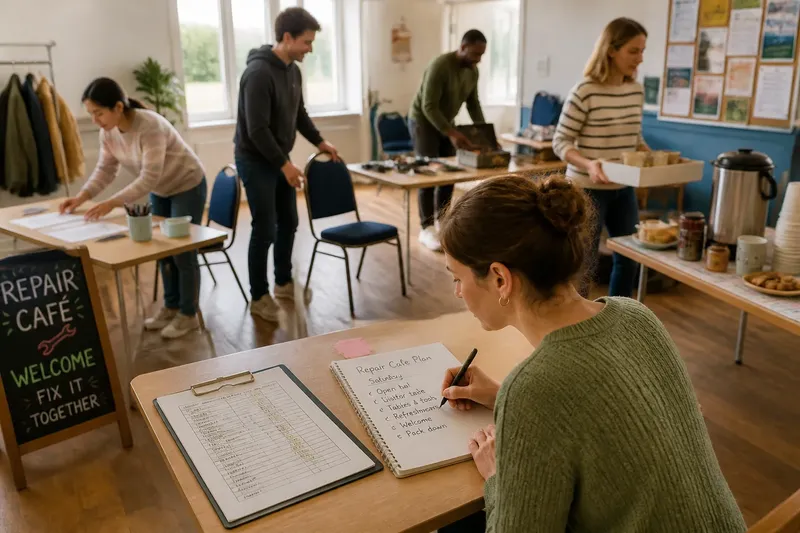
- Walk the room from a participant’s point of view. Try the entrance, a seat at the edge and a place furthest from the focal point. Adjust anything that makes participation needlessly difficult.
If the gathering includes several different tasks, a hybrid layout can spare a full rearrangement. For instance, rows can face a presentation area while small tables sit to one side for later group work. Make the transition explicit, and leave enough space that moving from one activity to the next does not become the main event.
Which layout suits common gathering questions?
Can people join a discussion from rows?
Yes, if you make room for a turn towards a neighbour or a short paired conversation. Rows are less helpful when the discussion depends on people responding directly across the group.
Are circles suitable for larger groups?
They can be, but people at the far side may struggle to hear or see one another. A horseshoe, or several smaller circles with a clear way to share points back, may be easier to use.
Do small tables always encourage participation?
No. They create a convenient setting for conversation, but the activity still needs a clear prompt and a way for each person to contribute. Without that, one confident voice can occupy the table while others become attentive furniture.
Can one room layout serve the whole gathering?
Often, if the activities are similar. When the session shifts from listening to group work, a planned change may help more than asking everyone to adapt to a shape chosen for the opening.
What should you settle before people arrive?
Set out the layout, then check sightlines from the least convenient seats. Put pens, paper or other shared materials within reach, and make sure the entrance and routes remain clear. If chairs or tables are difficult to move, choose the best workable arrangement rather than relying on a mid-session furniture rescue.
Tell participants what the arrangement is for in a simple sentence: “We’re using tables so each group can compare suggestions,” or “We’re in a circle so we can hear responses across the room.” That small explanation gives people a reason for the shape and helps them understand how to take part.
For a circle, rows or small tables, the useful question is not which layout looks most welcoming but which makes the next activity easiest to join. Choose the shape for that action, and keep a spare chair or two accessible; a gathering can change as soon as someone arrives who was not in the room when the plan was made.