A Handover That Keeps the Useful Context
A project handover checklist preserves decisions, unfinished tasks and the next contact, so incoming community helpers can continue without rebuilding the story.
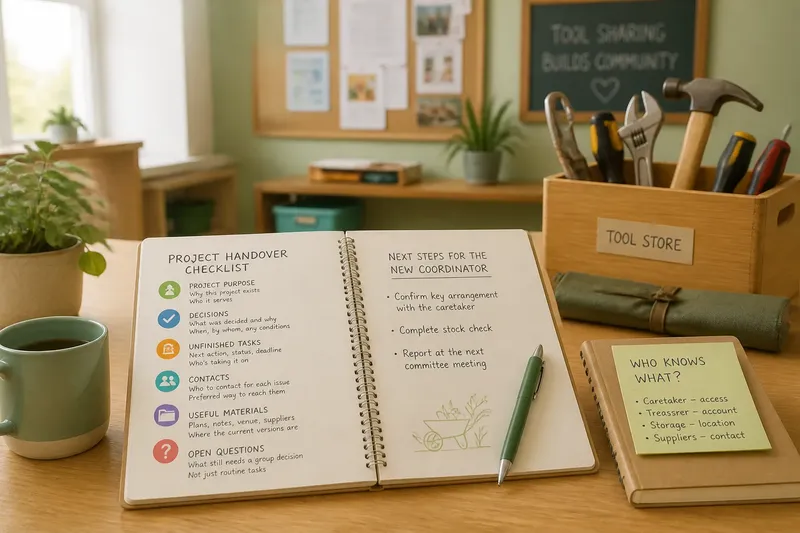
The common handover mistake is to pass on a folder of files and call the job done. The cost is less visible: incoming helpers spend their first meeting retracing decisions, chasing vague tasks and guessing who can answer a question. A useful project handover checklist preserves the reasoning and relationships that make those files usable.
In a community project, people often contribute between other commitments. A neighbourhood garden, repair café or shared hall may have no single person whose memory can be summoned on demand. The handover needs to make the work legible without requiring the outgoing helper to write a history of every conversation.
What should a project handover checklist preserve?
Keep the record focused on what someone needs to decide or do next. That usually means three connected things: decisions already made and why; unfinished work and its current state; and the person or group to contact when the next choice cannot be made from the notes.
Use a shared document, such as a Google Doc or a file in the group’s existing shared drive, rather than scattering details across email, chat and personal notebooks. The document can link to source files, but it should still make sense if a link is missed or a folder is renamed.
- Project purpose: State what the group is trying to achieve and who it is intended to serve.
- Decisions: Record the choice, the date or meeting where it was made, who agreed, and any important reason or condition.
- Unfinished tasks: Describe the next action, current status, relevant deadline or dependency, and who has agreed to take it on.
- Contacts: Name the next point of contact for each live issue, with their preferred way to be reached if they have agreed to share it.
- Useful materials: Link to current plans, meeting notes, venue details, supplier correspondence or shared records, and identify which version is current.
- Open questions: Separate matters that still need a group decision from routine tasks that someone can complete within an existing agreement.
That last distinction prevents an incoming helper from treating an old discussion as settled policy—or reopening a decision simply because its background was not recorded. A note can be brief: “Choose the date at the next committee meeting; the venue has only offered these options.”
Which handover fits your situation?
Is the project continuing with a new coordinator?
Use a working handover that points to the next decisions and current responsibilities. The incoming coordinator needs to know which commitments are active, who owns each one, and what authority the group has already given them. Keep the record practical rather than chronological; a transcript of every planning meeting is rarely the best route to the next action.
For a recurring activity, include the operating details that are easy to overlook: how the venue is booked, where the materials are stored, who holds the shared account, and which arrangements need renewing. Do not put passwords in an ordinary handover document. Use the group’s approved account-recovery or access-sharing method.
Is a short-term helper finishing one defined task?
Use a task handover, not a full project dossier. Record what the helper was asked to deliver, what is complete, what remains, and any choice that needs approval before work continues. Add the location of the relevant files and the name of the person who can accept or revise the work.
This suits jobs such as preparing a community noticeboard, gathering venue options or organising donated materials. It avoids asking a person who did one bounded task to document the whole project, while still making their contribution easy to pick up.
Has the project paused or lost its usual organiser?
Use a recovery handover with a clear distinction between confirmed facts and things that need checking. Mark commitments that may have expired, contacts whose role is uncertain, and decisions that depended on circumstances that may have changed. The first incoming task is then to verify those points, not to act on stale notes as if they were current.
If there is no outgoing coordinator available, ask two or more people who know different parts of the work to review the record. One may know the venue and another the group’s agreement; together they can identify gaps without presenting one person’s recollection as the whole record.
Is the work ending rather than transferring?
Use a closure handover that says what will stop, what remains available, and who can answer questions about records or belongings. Note any commitments the group still needs to fulfil, such as returning borrowed equipment or telling participants that a regular gathering is ending. A project should not be described as complete while an unresolved obligation is simply left without an owner.
How much explanation belongs beside a decision?
Capture enough context to show what the decision covers and what it does not. “Use the library room” is thin. “The group chose the library room for meetings because it is accessible by public transport; this choice applies to the planning sessions, not the public event” gives a successor something they can apply.
Record the basis in plain language, not as a verdict on people who preferred another option. Useful context may include a constraint, a preference the group tried to accommodate, or a condition that would justify revisiting the choice. Avoid attributing private comments or sensitive personal information unless there is a clear, appropriate reason to keep them.
Say you are handing over a local tool-sharing project. The outgoing organiser records that the group agreed to keep the tool store at the community centre because its caretaker can open it during agreed sessions; the key arrangement is still awaiting confirmation. They list the stock check as unfinished, name the member who volunteered to contact the caretaker, and identify the committee meeting where any change to storage arrangements must be agreed. The new coordinator can follow up without treating the location as either a settled permanent rule or an entirely fresh question.
How do you make unfinished tasks transferable?
Write tasks so another person can tell what a next action looks like. “Sort the equipment” leaves the scope and authority unclear. “Compare the inventory with the labelled boxes, then bring missing items to the committee before ordering replacements” tells the next helper what to do and where the decision boundary sits.
For each open task, include:
- Current state: What has already happened, and what evidence or file records it?
- Next action: The next observable piece of work, rather than a broad ambition.
- Owner: The person who has agreed to act, or the group that still needs to assign someone.
- Dependency: Any answer, permission, resource or decision that must come first.
- Decision boundary: What the helper may do independently and what must return to the group.
Do not assign an unfinished task to a named person merely because they are taking over the document. If nobody has accepted it, write “owner to be agreed” and identify who will bring that question to the group. That is more useful than creating an imaginary commitment.
Who should be the next point of contact?
Match the contact to the issue, rather than listing one general name beside every question. The venue caretaker may know access arrangements; the treasurer may handle approved spending; the committee may need to decide a change in scope. A handover can name a primary contact and a backup where continuity matters.
Check that people have agreed to have their contact details shared, and use the group’s normal channel where possible. If the contact is a role rather than a person, name the role and say how to reach it—for example, “send a message to the hall committee account”. This keeps the document useful when volunteers change.
Where a decision belongs to the whole group, do not imply that a contact person can make it alone. State how the question should reach the group, such as adding it to the next meeting agenda or raising it in the established shared discussion space. The route matters as much as the name.
What should you do before calling the handover complete?
Ask the incoming helper to read the document and point out what they cannot tell from it. This is a short review, not a test: unclear ownership, unexplained abbreviations and links that lead to old versions are easier to fix before the outgoing person disappears into other commitments.
Then agree who will maintain the record and where the current copy lives. Give it a clear title and date, and mark older versions as superseded rather than leaving several files named “final”. If the group keeps minutes separately, link to the relevant meeting record instead of copying a second version that may drift.
For a project handover checklist, the useful standard is simple: a new helper can see what the group decided, what is still open, what they may do next and whom to ask. The record need not preserve every conversation. It should preserve the point at which the next person can continue responsibly.